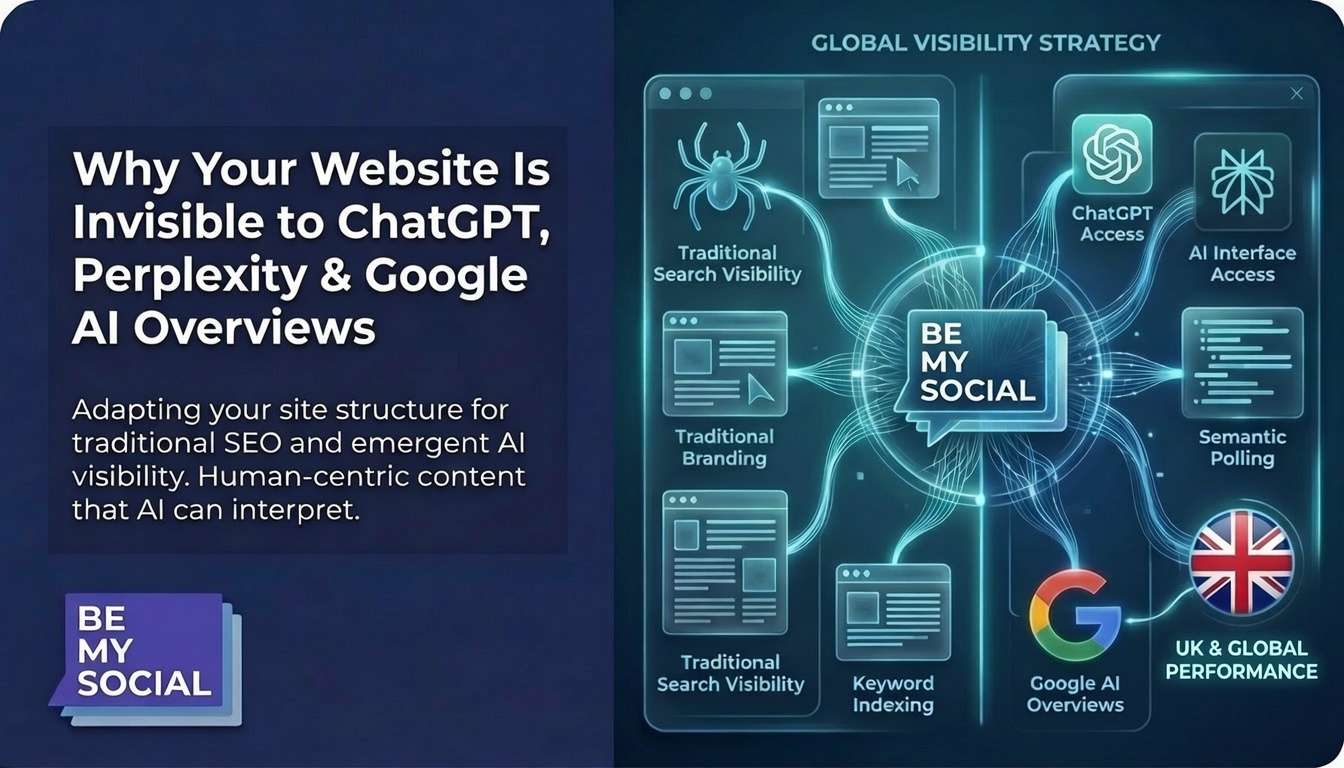


“Your site ranks on the first page of Google. Your content is solid. Yet when a potential customer asks ChatGPT, Perplexity or Google AI Overviews the exact question you answer, your brand never appears.”
That is the new reality of search in 2026. Traditional rankings no longer guarantee visibility. AI systems now decide what information users see first, and most websites remain completely invisible to them.
What You’ll Learn
- Why ranking well on Google no longer means AI engines will cite you
- The main technical and content reasons sites stay invisible to ChatGPT, Perplexity and Google AI Overviews
- Exact steps to open your site to AI crawlers without feeding training data if you prefer not to
- How to structure content so AI systems can extract and cite it
- Practical schema, entity and freshness tactics that raise citation rates
- How Be My Social helps UK businesses become visible inside AI answers
Let's Get Your Website Visible Again
Introduction
In 2026, more than half of Google searches trigger an AI Overview and a growing share of discovery happens inside ChatGPT and Perplexity. Your website can rank highly in traditional results yet remain invisible to the systems now shaping recommendations and answers. This article explains precisely why that happens and gives you a clear, actionable plan to fix it. At Be My Social we help brands across the UK close this visibility gap so they appear where modern customers actually look.
Why Traditional SEO No Longer Guarantees AI Visibility
Search has split into two parallel systems. Google’s classic ranking algorithms still matter for the blue links that remain. AI answer engines operate differently. They retrieve, extract and cite content based on crawl access, structured signals, answer readiness and authority cues that traditional SEO often overlooks.
Research shows only limited overlap between pages that rank in Google’s top ten and pages that AI systems actually cite. A site can sit in position one yet never be mentioned when a user asks the same question in ChatGPT or sees an AI Overview. Zero-click behaviour has also risen sharply. When an AI Overview answers the query on the results page, many users never click through. Visibility inside the answer itself has become the new priority.
The Real Reasons Your Website Stays Invisible
Several common issues keep sites off the radar of ChatGPT, Perplexity and Google AI Overviews.
Blocked AI crawlers
Many robots.txt files still contain blanket rules written years ago. They block GPTBot, OAI-SearchBot, ChatGPT-User, PerplexityBot, Claude bots or Google-Extended. If the crawler cannot access the page, the content cannot be cited. This is the single most frequent and easiest problem to solve.
Missing or incomplete structured data
AI systems rely on clear machine-readable signals. Without Organisation, Person, Article, FAQPage or HowTo schema, they struggle to understand who you are, what you offer and which facts they can safely extract.
Content that is hard to extract
Long narrative paragraphs, buried answers and vague headings make extraction difficult. AI systems prefer short, self-contained blocks that answer a question directly.
Weak entity and authority signals
AI engines favour sources with consistent brand entities across the web, named authors with credentials, original data and clear E-E-A-T signals. Generic, anonymous content is routinely skipped.
Outdated or slow pages
Freshness matters more for AI citations than for classic rankings. Pages that have not been updated in over a year lose visibility. Slow load times also reduce crawl priority and citation rates.
No guidance for language models
The emerging llms.txt file acts as a curated map for AI systems. Most sites still lack one, missing an easy early-adopter advantage.
Exactly How to Fix It in 2026
1. Open the right doors in robots.txt
Audit your robots.txt immediately. Explicitly allow the search and retrieval bots while deciding separately on training crawlers:
- Allow OAI-SearchBot, ChatGPT-User, PerplexityBot and equivalent retrieval agents
- Decide consciously on GPTBot and Google-Extended according to your content policy
Add a clean, accessible XML sitemap. Confirm that important pages are not blocked by noindex tags or accidental disallow rules.
2. Add and validate schema markup
Implement JSON-LD for:
- Organisation (with contact details, sameAs links and founding information)
- Person (authors with credentials and external profiles)
- Article or BlogPosting (with dates and author)
- FAQPage and HowTo where relevant
Test every page in Google’s Rich Results Test and Schema Markup Validator. Clean, valid schema gives AI systems confidence to cite you.
3. Restructure content for extraction
Lead every key section with a direct answer. Turn H2 and H3 headings into the exact questions people ask. Keep paragraphs short and self-contained (roughly 50–150 words). Use lists, tables and clear definition blocks. Add a structured FAQ section on high-value pages. These formats are far easier for AI systems to pull and attribute.
4. Strengthen entity and authority signals
Ensure your brand name, description and key facts remain consistent across your website, LinkedIn, industry directories and any knowledge-graph sources. Publish original data or research where possible. Name authors and give them proper bios with verifiable credentials. Update high-priority pages at least quarterly and display clear “last updated” dates.
5. Improve technical performance
Target strong Core Web Vitals, especially Largest Contentful Paint under 2.5 seconds. Compress images, eliminate unnecessary render-blocking resources and ensure HTTPS is correctly configured. Fast, stable pages are crawled more thoroughly and cited more often.
6. Add an llms.txt file
Place a simple llms.txt file at the root of your site. Use it to summarise what your business does and point AI systems to your most important pages and resources. This emerging standard remains under-used, so early adoption can give you an edge.
7. Monitor and iterate
Regularly test relevant queries in ChatGPT (with browsing), Perplexity and Google AI Overviews. Track brand mentions, citation frequency and the context in which you appear. Combine these checks with traditional analytics so you can refine the pages that matter most.
How Be My Social Helps You Become Visible to AI Systems
At Be My Social we specialise in the full spectrum of modern visibility work. Our team combines technical SEO, content strategy, schema implementation and social amplification so your brand is discoverable both in classic search and inside AI answers. We audit crawler access, implement structured data, restructure content for extraction and build the authority signals AI engines trust. Because we also manage social media and content creation, we strengthen the wider entity presence that generative systems notice.
Whether you need a one-off technical repair or ongoing AI search optimisation, we deliver practical results for UK businesses that want to stay visible in 2026 and beyond.
Conclusion
Ranking on Google is still valuable, yet it is no longer enough. ChatGPT, Perplexity and Google AI Overviews now shape a large and growing share of discovery. Sites that remain invisible do so for clear, fixable reasons: blocked crawlers, missing structure, extractable content gaps and weak authority signals. By opening the right technical doors, adding schema, rewriting for answers and reinforcing your entity presence, you can move from invisible to cited. The competitive window is still open. Act now and your brand can appear in the answers that matter.
Get Started Today
Ready to make your website visible to ChatGPT, Perplexity and Google AI Overviews? Contact the team at Be My Social for a practical review of your current setup and a clear action plan.
Call us on 03305 519 900
Email hello@bemysocial.com
Visit us at 8 Priory Pl, Doncaster DN1 1BL, United Kingdom
Frequently Asked Questions
Many business owners ask the same practical questions once they realise their site is invisible to AI systems. Here are clear answers to the most common ones.
Google rankings and AI citation decisions use different signals. Crawl access, structured data, answer-first formatting and entity strength matter more for AI systems than classic ranking factors alone.
You can choose to block training crawlers while still allowing search and retrieval bots. Blocking everything usually means you disappear from AI answers entirely. A selective robots.txt approach gives you control without total invisibility.
Technical fixes such as crawler access and schema can start showing effects within weeks. Building stronger authority and content signals typically takes longer, often three to six months of consistent work.
Yes. Strong technical SEO and indexing remain the foundation. AI systems still need to discover and trust your content. Think of classic SEO as the on-ramp and AI optimisation as the destination.
Check your robots.txt and confirm that the main AI search crawlers can access your key pages. Everything else becomes secondary if the crawlers cannot read the content.
Peter
Peter Bezuidenhout is an SEO and digital marketing specialist based in KZN, South Africa, with a strong focus on serving UK and international clients. With nearly twenty years of experience, he helps brands increase their visibility and achieve growth through strategic SEO, results-driven campaigns, and creative content. His action-oriented, data-driven approach is tailored to help businesses thrive in today’s fast-paced digital world. Passionate about digital innovation, Pieter continues to deliver impactful results for his clients
A no-fuss attitude and a speedy turnaround!
I’ve found the to be the very best company for us after trying several others over the years.
I’m glad to have them, because the cost of hiring someone directly to do the same work would be impossible.
Highly recommended.

Ruth and Emily are amazing, they are always on hand to answer any questions and explain everything thoroughly.

Our contact Ruth always makes herself available for telephone/zoom meetings, constantly checks up on how sales are progressing and advises on changes to marketing strategies to try and ensure increased traffic to the website. I cannot recommend them highly enough 🙂

Discover More Insights: Explore Our Blog for Expert Tips and Strategies!

Graphic Design Services in Doncaster & Yorkshire
Professional graphic design services in Doncaster and Yorkshire for businesses that want to stand out and convert. Pretty pictures are easy. Designs that build recognition, win trust and generate enquiries

Graphic Design Services UK | Be My Social 2025
Discover the differences between graphic design and illustration in 2025, plus AI’s role. Get professional, human-led graphic design services in the UK from Be My Social for authentic branding and marketing impact.

Social Media Design Trends 2026 for UK Service Businesses: Bold Typography and Grainy Textures Guide
In a crowded digital landscape, a striking social media post can stop the scroll and win a customer in seconds. Imagine your Yorkshire plumbing business post featuring bold, oversized typography

How AI Search Optimisation Helps Small Businesses in Yorkshire Appear in AI Answers 2026
Imagine a potential customer in Leeds or Sheffield asking, “best local plumber for emergency repairs near me,” and receiving an instant, tailored recommendation from ChatGPT or Google AI Overviews, without

Hyper Local SEO Strategies for Doncaster Businesses: Targeting Neighbourhoods Like Thorne and Mexborough
A local resident in Thorne searches “emergency locksmith near me” on their phone while locked out at 10pm. Will your Doncaster business appear in the results, or will a competitor

How to Use Google Business Profile and Local Citations for Locksmiths, Plumbers, Roofers and Electricians in Yorkshire to Gain More Customers
A homeowner in Sheffield faces a burst pipe at midnight or a resident in York needs an emergency locksmith after a break-in. In 2026, these urgent searches often start with