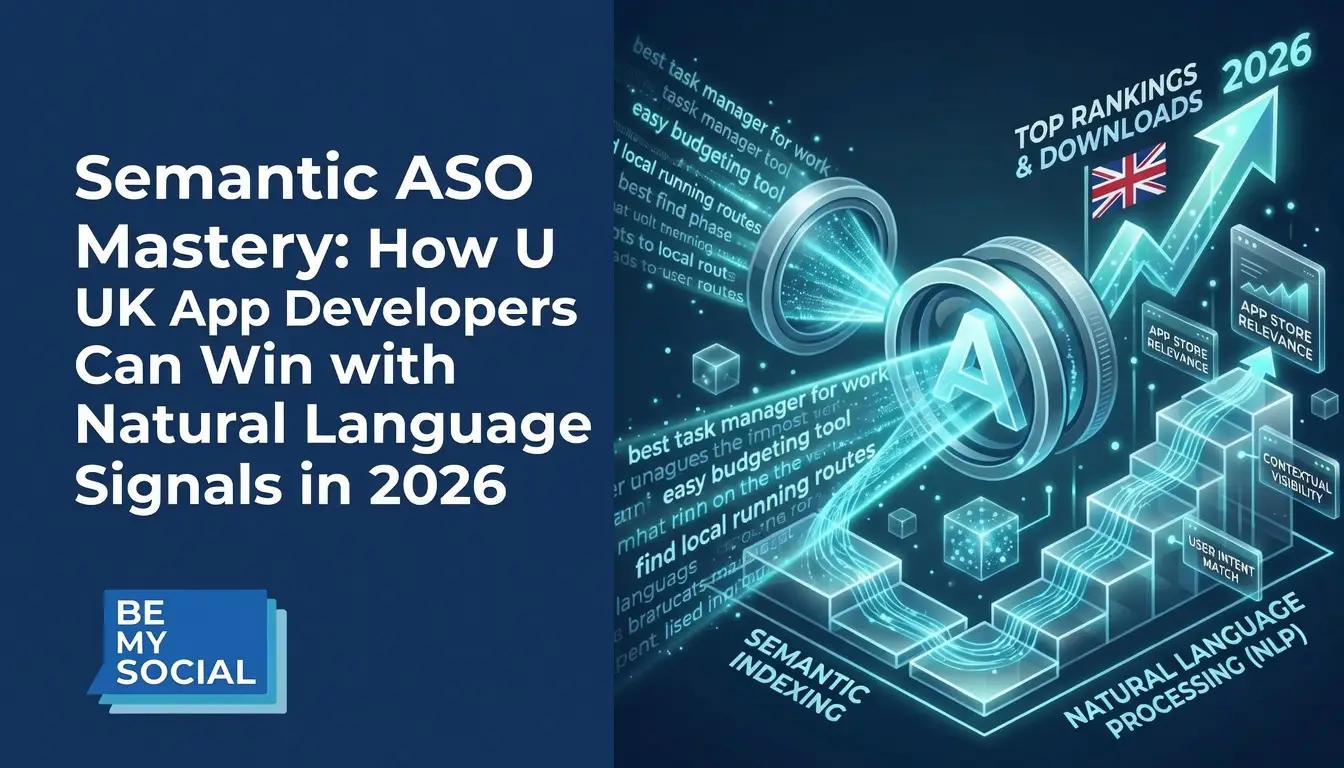
“In today’s Google Play Store, simply cramming keywords into your app description is no longer enough. UK app developers who master semantic signals and natural language alignment are seeing stronger rankings, broader discoverability, and higher conversion rates even as competition intensifies.”
Key Areas We Will Cover:
- The shift from keyword stuffing to semantic relevance in ASO
- How Google interprets app metadata using natural language understanding
- Practical techniques to strengthen category confidence and entity signals
- Combining semantic optimisation with visuals, reviews, and updates
- Measuring success and building a resilient UK-focused ASO strategy
- How BeMySocial supports British developers and businesses
Semantic ASO: The Smart Way Forward for UK Mobile Apps
App Store Optimisation remains one of the most powerful, cost-effective channels for UK businesses to grow their mobile apps organically. However, the rules of the game have changed. Google Play now relies heavily on advanced natural language understanding to evaluate what your app offers, who it serves, and how well it matches user needs.
At BeMySocial, we work with UK developers and brands to move beyond outdated tactics and build metadata that performs in this semantic era. This guide shares clear, actionable strategies to help your app stand out on Google Play while delivering genuine value to British and international users.
Let’s Discuss Your ASO Needs
Why Old-School Keyword Tactics Are Fading Fast
Google Play’s ranking systems have evolved into continuous, learning-based models. Exact-match repetition and rigid keyword placement now deliver diminishing returns. Instead, the algorithm seeks to understand context, user intent, and real-world usefulness.
For UK teams, this means creating descriptions that read naturally for British audiences while clearly communicating your app’s purpose. Apps that embrace this semantic approach often enjoy more stable rankings and appear in a wider variety of relevant searches, including long-tail and conversational queries popular with UK users.
Understanding How Google Reads Your App Listing
Google analyses your title, short description, and full description much like a knowledgeable reviewer would. It looks for clear signals about functionality, benefits, and relevance rather than simple word counts.
This natural language approach helps the store surface your app to the right people at the right time. By aligning your metadata with these signals, you improve the chances of strong category placement and broader visibility across semantic clusters.
Building Strong Semantic Foundations for Your Metadata
Focus on these core elements to strengthen how Google interprets your app:
Clear, Benefit-Driven Language
Write descriptions that speak directly to user problems and outcomes. UK audiences respond well to straightforward, trustworthy messaging that highlights practical value without exaggeration.
Strategic Entity Placement
Highlight key features, use cases, and concepts naturally throughout the text. Place the most important elements early and reinforce them thoughtfully to help the algorithm recognise what makes your app unique.
Category Alignment and Confidence
Aim for metadata that strongly matches your primary category while building relevance in related areas. This expands the range of searches where your app can appear and improves resilience during algorithm adjustments.
Test different versions of your descriptions to see which combinations deliver the clearest signals of relevance and user focus.
Beyond Text: Creating a Complete Semantic Experience
Strong metadata works best when supported by other listing elements:
- Visual Assets — Use screenshots and preview videos that clearly demonstrate the features mentioned in your text, building a consistent story for both users and algorithms.
- User Reviews and Ratings — Positive, detailed feedback reinforces semantic understanding. Encourage genuine reviews and respond professionally to build trust.
- Regular Updates — Fresh content and features signal ongoing value, helping maintain strong performance signals.
- Localised Variations — Tailor messaging for UK English while keeping core semantic strength intact for broader reach.
This holistic approach turns your app listing into a compelling, coherent presence that converts browsers into loyal users.
Measuring and Refining Your Semantic ASO Efforts
Track more than just rankings. Monitor impressions, conversion rates, keyword coverage, and install sources to understand what’s working. Tools that reveal semantic insights, combined with Google Play Console data, help you iterate effectively.
UK businesses should also consider how their apps perform across different English-speaking markets and adjust accordingly while maintaining a strong domestic foundation.
Regular testing and refinement keep your strategy aligned with evolving user behaviour and platform capabilities.
Why UK App Success Depends on Semantic Strength
With a thriving UK tech scene and global ambitions, British developers benefit hugely from ASO approaches that prioritise clarity and relevance. Semantic optimisation helps you compete against larger players by creating listings that feel helpful and authentic to real users.
This user-first mindset also supports better paid user acquisition results and stronger long-term retention.
Conclusion
Semantic ASO represents the future of sustainable app growth on Google Play. By focusing on natural language signals, clear user benefits, and holistic listing quality, UK developers can achieve better visibility, higher conversions, and more predictable organic performance in 2026 and beyond.
The apps that win will be those that communicate value clearly both to people and to the intelligent systems evaluating them.
Get Started Today
Ready to elevate your app’s performance with modern semantic ASO techniques? Our team at BeMySocial specialises in data-driven app store optimisation, creative asset development, and integrated paid strategies tailored for UK businesses.
Contact us at 03305 519 900 or email hello@bemysocial.com to discuss how we can help boost your downloads and rankings. Visit BeMySocial.com or our contact page to get started. 8 Priory Pl, Doncaster DN1 1BL, United Kingdom.
FAQ
Semantic ASO focuses on creating natural, meaningful metadata that helps Google understand your app’s purpose and value. It delivers broader visibility and greater stability compared to traditional keyword stuffing tactics.
Google Play places a stronger emphasis on full-description text and semantic understanding, while Apple focuses more on title, subtitle, and keyword field precision. A tailored approach for each store works best.
Yes, but the focus shifts to user intent and semantic clusters. Combine keyword insights with natural, benefit-focused writing for optimal results.
Every 4–8 weeks is a good cadence for most apps, or more frequently when adding significant features or responding to seasonal opportunities.
Absolutely. We combine advanced semantic optimisation with targeted paid user acquisition to deliver faster growth and stronger ROI for UK app businesses.
Peter
Peter Bezuidenhout is an SEO and digital marketing specialist based in KZN, South Africa, with a strong focus on serving UK and international clients. With nearly twenty years of experience, he helps brands increase their visibility and achieve growth through strategic SEO, results-driven campaigns, and creative content. His action-oriented, data-driven approach is tailored to help businesses thrive in today’s fast-paced digital world. Passionate about digital innovation, Pieter continues to deliver impactful results for his clients
A no-fuss attitude and a speedy turnaround!
I’ve found the to be the very best company for us after trying several others over the years.
I’m glad to have them, because the cost of hiring someone directly to do the same work would be impossible.
Highly recommended.
Ruth and Emily are amazing, they are always on hand to answer any questions and explain everything thoroughly.
Our contact Ruth always makes herself available for telephone/zoom meetings, constantly checks up on how sales are progressing and advises on changes to marketing strategies to try and ensure increased traffic to the website. I cannot recommend them highly enough 🙂
Discover More Insights: Explore Our Blog for Expert Tips and Strategies!

Paid Media Trends 2026: What UK Businesses Need to Know for Stronger Results
“With rising costs, stricter privacy rules, and rapid platform evolution, UK businesses that adapt their paid media strategies in 2026 will capture more attention, drive better ROI, and stay ahead

TikTok Sale Update 2026: What the US Deal Means for UK Businesses and Marketers
“The TikTok US sale has now closed, bringing greater stability to the platform in America. For UK businesses and marketers, this development offers reassurance, potential opportunities, and important lessons about

Keyword Ideas: What the Data Really Tells You About Search Demand in 2026
“Search volume alone no longer guarantees visibility. With audiences spreading across Google, TikTok, YouTube, Instagram, and AI tools like ChatGPT, Perplexity, and Grok, understanding where demand truly lives is the

Social-First Strategies: How UK Businesses Can Boost Visibility Across Search and Social in 2026
“Discovery no longer begins on Google alone. UK consumers research, compare, and validate choices across social platforms, communities, and AI tools first making a social-first approach essential for any business

Creative Typography in 2025: Why It Matters for Your Brand and Design
Creative typography does far more than make words look nice. It shapes how people feel about your brand in seconds, influences trust, boosts readability, and drives engagement. For businesses in

5 Reasons Why You Should Use Email Marketing Campaigns
Email marketing continues to outperform almost every other digital channel, delivering an average return of £36 to £45 for every £1 spent in 2026. For businesses in Yorkshire, from Doncaster